From Care to Capacity: Strengthening Child Care Systems in the South Sound
As funding shifts reshape child care & early learning systems, families, providers, and community leaders continue to work to strengthen support locally.

Focusing On the Big Picture
Businesses, nonprofits, health care facilities, and schools can't thrive in communities that lack available, affordable child care. Families can't either. Parents can't earn a living without child care providers who are reliable, knowledgeable, and accessible.
Nonetheless, Kevin Shutty, Director of the Mason County Economic Development Council says, "A lot of people still think that child care is a women's issue. But it's a critical issue for our whole economy. Here in our county, during the pandemic, people really woke up to the reality that it's critical for all our employers, for small businesses, and for anyone who wants to start a business. It's critical for workforce recruitment and retention everywhere, in every field."
To address the unmet needs for accessible, affordable child care, the Mason County Economic Development Council is leading a county-wide project to create a strategic plan to strengthen the community's child care systems.
A wide range of stakeholders is involved: Mason Matters, a broad public health-focused coalition; child care providers; nonprofits; Congressional staff; community college staff who teach child caregiving and run a child care facility; private child care providers; and employer groups from every economic sector are involved. Together, they are analyzing what child care resources exist, how they are financed, regulated and governed, who provides them, and where there are gaps in services, access, and quality. This work and a similar effort in Thurston County are funded by state grants that end in June. The big question for Mason County, Shutty says, is "What can we do to achieve collective system improvements?"
The work led by the Mason County EDC involves monthly meetings attended by about 30 people. "The level of energy and interest in this work is very high," Shutty marvels, "So we need to honor that energy by producing a good, strong product." Once that strategic plan is in place, implementing it will become part of the whole community's agenda.
A Working Parent's Challenges
Most parents are unaware of the swirl of policy and budget debates about child care. Jessica, for instance, just wants her two toddler boys to be cared for in a safe, stable and stimulating place that is close to where she works, and open at least nine hours a day so she has time to get the kids there, work an eight-hour shift, and get back to pick them up.
She also prefers a home-based care situation. "The bigger places might have more toys, but they also have more diseases," she says. "Hand foot and mouth disease is awful, and it's really common. When the kids get sores in their mouths it hurts to eat."
She and other parents she knows find child care providers on Google, but that's not always reliable1. "The Google listings are not always up to date. For instance, the woman who takes care of my kids now has a new phone number. She doesn't know how to get Google to update it online. Also, if you have to work nights, it can be really hard to find someone." Word of mouth is often the fallback.
If there are other sources of information about how to find child care, she hasn't heard about them.
She is grateful for the state subsidy of Working Connections child care, which serves low- and medium-income families. "I'd be totally lost without it," she says.
"But you have to ask whether someone takes it," Jessica says. "Not all child care providers take payments from the state."
Child Care and Early Learning
In the past, "child care" was the system that provided regular care for children while their parents worked. Today, because of the rigorous qualifications for child care providers and the rising standards for educational activities in child care programs, "child care" has become more closely synonymous with "early learning" programs.
Some is in people's homes; some is in child care centers. Mostly, what we call child care or early learning is for babies, toddlers, and preschoolers. Some school-age children also attend child care. After school programs are more varied and informal, and include Boys and Girls Clubs, school-based programs, and other arrangements.
Child care provided for four hours or more per day by people who are not close relatives is required to be licensed by the state. Licensing requires proof of safe facilities. And licensing for child care providers has several elements: Caregivers must be 18 or older, pass a background check, have a high school diploma or GED, and complete a Child Care Basics training and First Aid/CPR certification. Additional training is required for caring for babies. All caregivers must also take at least ten hours per year of additional training. Licenses for child care center directors require additional education and training.
Now the two terms—"child care" and "early learning"—have become interchangeable, but two earlier programs—the federally funded Head Start, and the state-funded Early Education and Assistance Program (ECEAP) were the originators of the "early learning" label. These two programs are still distinct: They are tailored to serve young children facing the greatest barriers to opportunity: children experiencing poverty and those with physical, developmental, or other significant support needs. Both Head Start and ECAP can be operated as part day or school day class sessions, and the length of class time is dependent on what each program has been funded to provide. Their specialized help for children with disabilities and for families navigating complex needs is critically important. Both programs pioneered higher standards of professional education for child care providers, and recognition of the importance of early brain development.
Head Start has been on a funding and policy rollercoaster for the past year. The Trump administration started with a funding freeze which was quicky rescinded—but checks were held up for so long that some programs had to shut down for a few days because they couldn't make payroll. Five regional Health and Human Services offices were closed, which slowed decision making and payments. Then they were reopened. Next, a policy kerfuffle arose about DEIA—the A is for accessibility for kids with disabilities. Then some grants were rejected for noncompliance, presumably because federal decision-makers didn't have training on the Disabilities Act. Litigation solved that problem, but the Trump administration has appealed, and that appeal may eventually be heard.
Litigation was also required to reverse a decision that excluded kids whose parents had student visas or held other specialized legal immigration statuses. Even though the litigation was successful in reversing this decision, it depressed immigrant enrollment.
Early Learning Is Not Fully Protected in Current Budget Priorities
Natalie Chavez, Early Learning Access and Quality Manager at the Child Care Action Council, notes that “Child care providers are educators serving children at their most vulnerable stage of development—the stage that creates the foundation for all future learning. Early learning is not optional, it is crucial for societal success."
Yet its importance does not yet get the recognition it deserves as a cornerstone to the success of our economy, our public school students' academic success, or the civic health of our state. Unlike K-12 schools, early learning is not called out in our state constitution. The current state budget deficit makes it especially vulnerable.
"Recent budget and policy changes by the federal government have created more stress for Washington's early learning system, Chavez says. "Federal funding cuts to state government in areas like Medicaid and the Supplemental Nutrition Assistance Program (SNAP) have resulted in our state legislature being forced to reallocate funding from other areas, including early learning, in its attempt to make up the loss."
Funding for child care has always been in short supply, but lately it's also become unpredictable. Funding for early learning programs already took a hit last year, with a significant reduction to Mental Health Consultation and the Dolly Parton Imagination Library. Last year, the state legislature wasn't able to deliver an expected increase in Working Connections Childcare—the main child care subsidy for low- to medium-wage working parents. This year, it faces a threat of cuts that may cap the number of families at 5,000, less than the number currently served. The estimated current enrollment is 39,000 families.
Families in the Working Connections program have to provide proof of income regularly, and if they earn more, and go over the line for even one pay period, they can lose their subsidy and have to reapply.
It's not possible to know how many families already need child care subsidies and don't get them, because many parents choose to keep children at home.
It's also unknown how many people apply to become licensed child care providers but don't make it through Washington's rigorous licensing process, which may take a year. Data from the Department of Children Youth and Families (DCYF) suggests that only an estimated 16.2% of children in Mason County between birth and age 5 are being served in early learning programs. That number increases slightly to 23.6% when looking only at preschool age children (3-5 years old). In Thurston County, the DCYF estimate is 24.6% for children aged birth to 5 years old and 31.9% for preschool aged children2. However, it is not known how many children are in illegal unlicensed care settings, or in the care of relatives, who are not required to be licensed due to lack of access to early learning programs rather than by family choice.
Philanthropic Sources of Funding for Child Care and ECEAP
There is not enough child care to meet the need, and there is little prospect of expanded government funding to provide more. Nor is there much hope of increased funding for post-secondary education and training to provide the well-trained child care center directors and other leaders needed for childcare. And there is no data on the amount, quality, or price of unlicensed private care.
But in Lewis County, the Ballmer Group is investing a reported $10 million in expanding ECEAP. This is part of the Ballmer Group's $170 million commitment to fund expansion of ECEAP statewide to serve all eligible children.
A second philanthropic initiative that has yet to be publicly announced is the creation of an 80-child early learning facility with a Montessori approach in Chehalis. It will be open 10 hours a day, five days a week, and be adjacent to other child-serving nonprofits.
How To Show Up and Support Efforts Locally
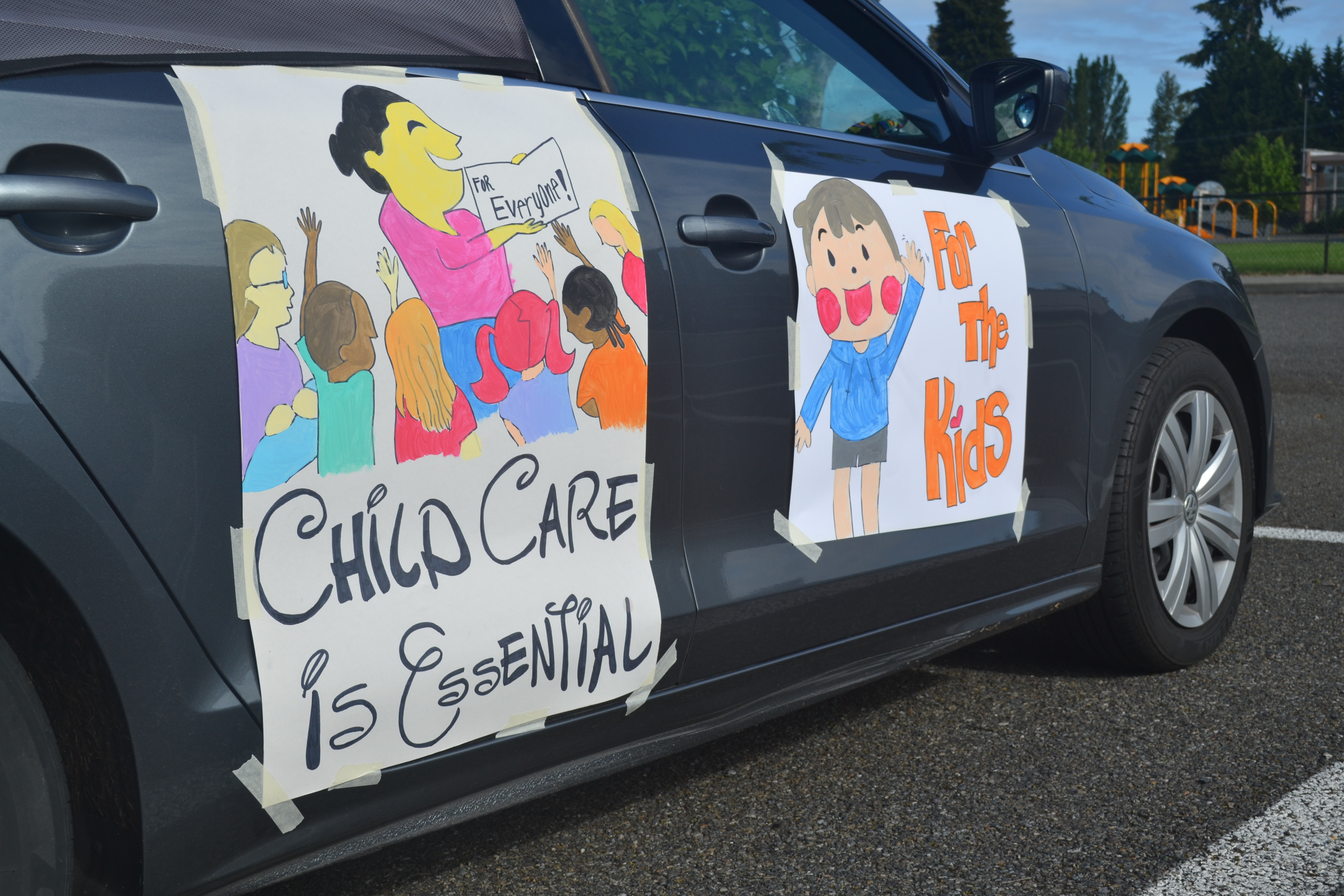
The strength of the South Sound has always come from its people—parents balancing work and family, educators caring for young children, employers who depend on reliable care, and neighbors who step forward to support what matters most.
As we shared in our recent story on The State of South Sound Nonprofits, even when challenges feel overwhelming, there is always something we can do.
- Give something. Support local organizations working to expand access to child care and early learning. This includes child care providers, early learning coalitions, and nonprofit organizations working to bridge the gap. We mentioned two organizations in this story, and there are many more that could use your support.
- Do something. Volunteer your time. Early learning centers, faith-based child care centers, Head Start and ECEAP classrooms, after-school programs, family resource organizations, and others all depend on community volunteers. Assist in classrooms, help families navigate enrollment processes, support literacy programs, or lend your skills behind the scenes. Even just a few hours a month can make a meaningful difference.
- Join something. Add your voice to statewide efforts dedicated to strengthening child care and early learning systems. Two opportunities to consider include the Early Learning Action Alliance (ELAA), coordinated through the Children's Alliance, and the Early Learning Advisory Council (ELAC), convened by the Washington State Department of Children, Youth, and Families. Both offer ways for community members, parents, providers, and advocates to stay informed, engage in policy discussions, and help shape the future of early learning in Washington.
Every thriving community depends on its youngest members—and on the people who care for them. Child care is essential infrastructure, shaping economic stability and educational success. The choices we make now will influence the future of the South Sound for years to come.
Sources:
1 Child Care Aware of Washington offers child care referral services through the Family Center. Families can receive help finding local child care by calling 1-800-446-1114 or visiting https://childcareawarewa.org/family-services/.
2 DCYF online dashboard: Child Care and Early Learning Need and Supply Data | Washington State Department of Children, Youth, and Families
Gallery
Explore more photos from this Community Story! Click to enlarge the photos below.